


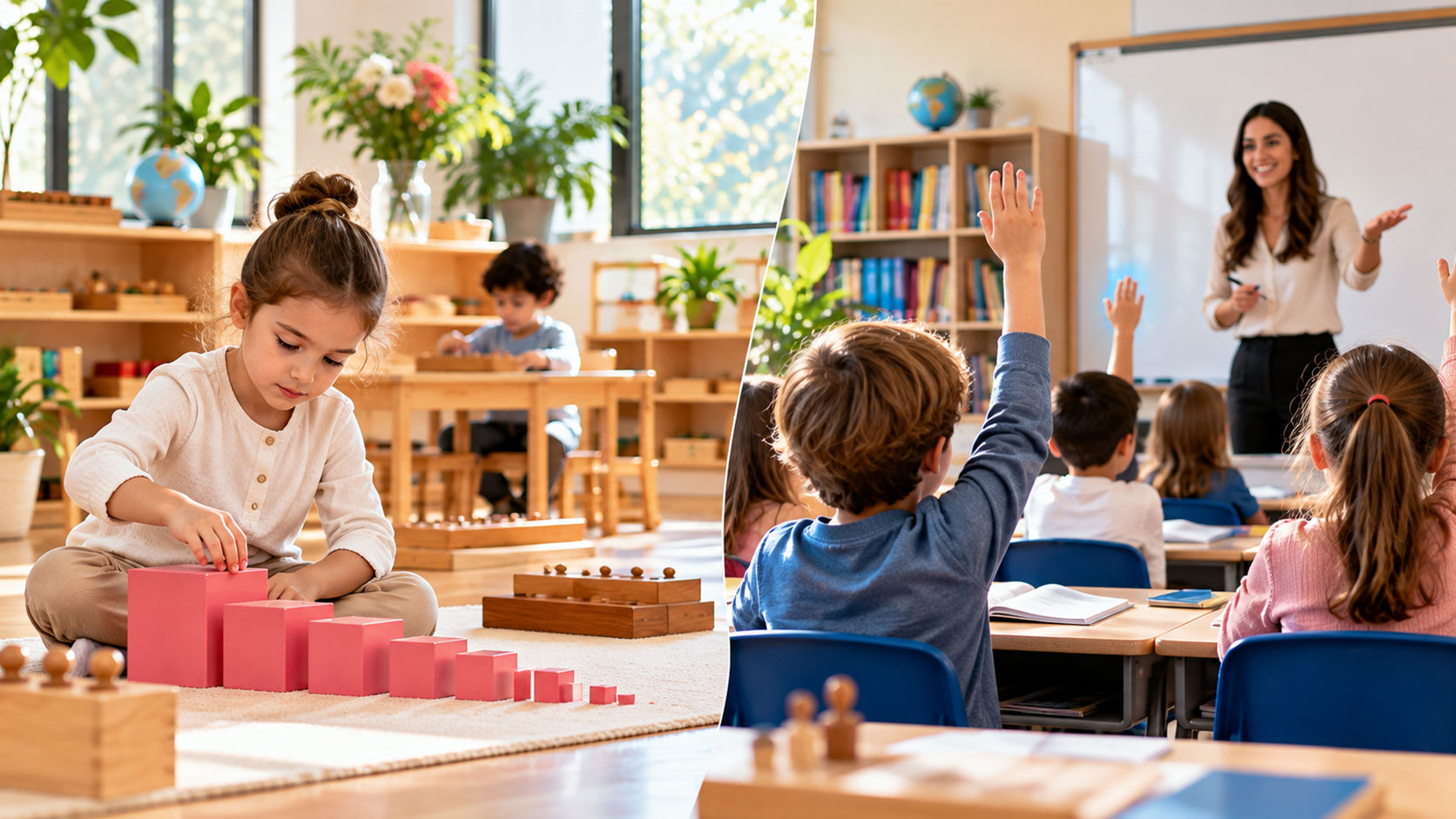
Choosing the right school is one of the most important decisions parents make for their children. Every family wants an educational environment where their child feels supported, develops confidence, and builds a strong foundation for future learning.
When comparing Montessori vs Traditional School approaches, parents often wonder which teaching method will better support their child’s academic progress, independence, creativity, and social development.
Montessori education emphasizes hands-on learning, individualized guidance, and opportunities for children to develop independence. Traditional schools often follow a more structured, teacher-directed approach with lessons organized around grade-level expectations.
Both educational models can offer meaningful benefits. The right choice depends on your child’s learning preferences, personality, developmental needs, and the quality of the individual school.
For families exploring private education in McKinney, Plano, and surrounding North Texas communities, understanding these differences can make the school selection process easier.
In this guide, we explore how Montessori and traditional schools compare and what parents should consider before choosing the best learning environment for their child.
Understanding the Montessori Teaching Method
Montessori education was developed by Dr. Maria Montessori, an Italian physician and educator who emphasized observation, independence, and the importance of a carefully prepared learning environment.
Her approach recognizes that children are naturally curious and capable of learning through purposeful interaction with their surroundings.
In a Montessori classroom, learning materials are typically organized within children’s reach. Educators introduce activities, observe progress, and guide children toward increasingly complex challenges.
Children often work independently or in small groups, choosing appropriate activities within established classroom expectations.
The objective is not unlimited freedom.
Instead, Montessori combines freedom of choice with responsibility, order, respect, and purposeful learning.
This balance is central to understanding how the method works.
How Traditional Private Schools Teach Children
Traditional schools often organize instruction by grade level, with teachers following a planned curriculum and introducing lessons to the class according to a shared schedule.
Students may participate in group instruction, complete assignments, practice skills, and demonstrate understanding through classroom activities or assessments.
This approach can provide consistency and clear academic progression.
Many children succeed in traditional classrooms, especially when educators offer effective instruction, individual support, and a positive learning environment.
However, the degree of flexibility can vary.
Some children may need additional time to understand a concept, while others may be ready to move further ahead.
Excellent traditional schools address these differences through differentiated instruction, small-group learning, and other teaching strategies.
The important question is not whether traditional education is inherently inferior. It is whether a particular school’s approach supports the individual child.
The Montessori vs Traditional School comparison becomes clearer when parents examine how each approach handles classroom instruction, learning materials, independence, and academic development.
Montessori vs. Traditional Schools: The Main Differences
When considering Montessori vs Traditional School options, parents should focus on how each classroom supports their child’s individual learning needs rather than assuming one approach is best for everyone.
One noticeable difference is the role of the educator.
In conventional classrooms, the teacher frequently directs lessons for the whole group.
In Montessori environments, the teacher generally combines direct presentations with observation and individualized guidance.
Another distinction involves how children engage with educational materials.
Montessori classrooms emphasize hands-on exploration. Students work with physical materials designed to introduce and reinforce concepts through active participation.
For example, a child learning mathematics may begin by handling quantities before progressing toward abstract symbols.
Traditional classrooms may also use manipulatives, but their balance of hands-on and teacher-directed learning differs by school.
Classroom organization can also vary.
Many Montessori programs use mixed-age groupings, allowing younger children to learn from older classmates while older children reinforce skills through collaboration and leadership.
Conventional schools more commonly organize students according to a single grade level.
Neither structure guarantees better results by itself. Teacher quality, implementation, resources, and student needs remain essential.
Why Independence Matters in Early Childhood Education
Consider a young child who spills water while completing an activity.
An adult may immediately clean it up.
In a Montessori classroom, the child may instead be encouraged to get an appropriate cleaning tool and participate in restoring the environment.
The educational value extends beyond cleaning.
The child practices coordination, responsibility, problem-solving, and persistence.
Similar learning opportunities occur when children organize materials, prepare simple activities, care for plants, or complete everyday classroom routines.
These experiences form part of Montessori Practical Life education.
They help children discover that they can contribute meaningfully to their environment.
Over time, appropriately supported independence can encourage confidence and a stronger sense of responsibility.
Academic Learning in a Montessori Classroom
Some parents wonder whether Montessori schools provide enough academic structure.
The answer depends on the program, curriculum implementation, and educational standards.
Authentic Montessori education includes structured learning materials and carefully sequenced experiences in areas such as language, mathematics, sensory development, and cultural studies.
Children may encounter letters through tactile materials, explore quantities using mathematical manipulatives, and develop vocabulary through discussions and classification activities.
The progression from concrete experiences to increasingly abstract understanding is an important element of the method.
Rather than viewing academics and independence as competing priorities, Montessori aims to connect intellectual development with concentration, self-direction, and active engagement.
Parents should still ask how a school evaluates learning, identifies difficulties, supports students who need additional instruction, and communicates academic progress.
No educational philosophy should replace clear expectations and effective teaching.
Social Development and Classroom Community
Parents often focus on academics when comparing private schools, but social and emotional development are equally important during childhood.
Young learners need opportunities to practice sharing, communicating respectfully, resolving disagreements, and participating in a community.
Montessori classrooms emphasize grace and courtesy, which involve everyday lessons in consideration, cooperation, and social responsibility.
Children learn to respect the work of others, wait when materials are being used, and contribute to maintaining an organized environment.
Mixed-age settings may also create opportunities for peer learning.
However, parents should examine the actual classroom culture rather than assuming that a particular school label guarantees positive relationships.
A supportive environment depends on how educators respond to children’s needs, establish expectations, and build trust.
Is Montessori Suitable for Every Child?
Montessori can be an excellent fit for children who enjoy hands-on exploration, meaningful choices, and opportunities to develop independence.
Yet it is important to avoid suggesting that one teaching method works best for everyone.
Some children thrive in highly structured, teacher-directed classrooms. Others respond particularly well to individualized activities and flexible work periods.
A child’s learning preferences may also change with age.
Families should consider temperament, developmental needs, communication skills, available educational support, and how the school handles transitions.
Visiting classrooms is one of the most useful ways to evaluate these factors.
A Montessori vs Traditional School decision should include firsthand classroom observations, conversations with teachers, and a clear understanding of how students receive academic and emotional support.
Seven Questions to Ask During a School Tour
Before selecting a Montessori or traditional private school in Texas, parents should ask how educators individualize instruction, what training teachers receive, and which ages the campus serves.
They should also ask how academic progress is assessed, how behavioral or learning concerns are addressed, and what communication parents can expect.
The final question may be the most revealing: What does a normal day actually look like for a child here?
A thoughtful school representative should be able to explain classroom routines, learning experiences, expectations, and available support clearly.
Whenever possible, observe students interacting with their teachers and classroom materials.
A school should be evaluated through its daily practices, not simply through photographs, slogans, or promises.
Discover Montessori Education in Plano and McKinney
At Happy Flower Montessori Academy, we value an educational environment where children can develop curiosity, independence, concentration, communication, and confidence.
Our Montessori approach emphasizes hands-on learning, meaningful activities, and guidance that recognizes individual development.
For families comparing private schools in Plano, McKinney, and nearby North Texas communities, visiting a Montessori environment offers an opportunity to see a different approach to early education.
Parents deserve to understand their options before making an important decision.
The best school is not necessarily the one with the biggest name. It is the one that thoughtfully supports your child’s growth, learning, and well-being.
The American Montessori Society provides additional information about Montessori philosophy, including child-centered learning, prepared environments, and the role of educators in supporting children’s development.
Plano location & contact:
📍 913 Lexington Dr., Plano, TX 75075
🌐https://www.happyflowermontessori.com/
McKinney location & contact:
📍 3801 Alma Rd., McKinney, TX 75070
🌐https://www.hfmontessorimckinney.org/
📞 +1 (682) 351 9492
Leave a Reply