


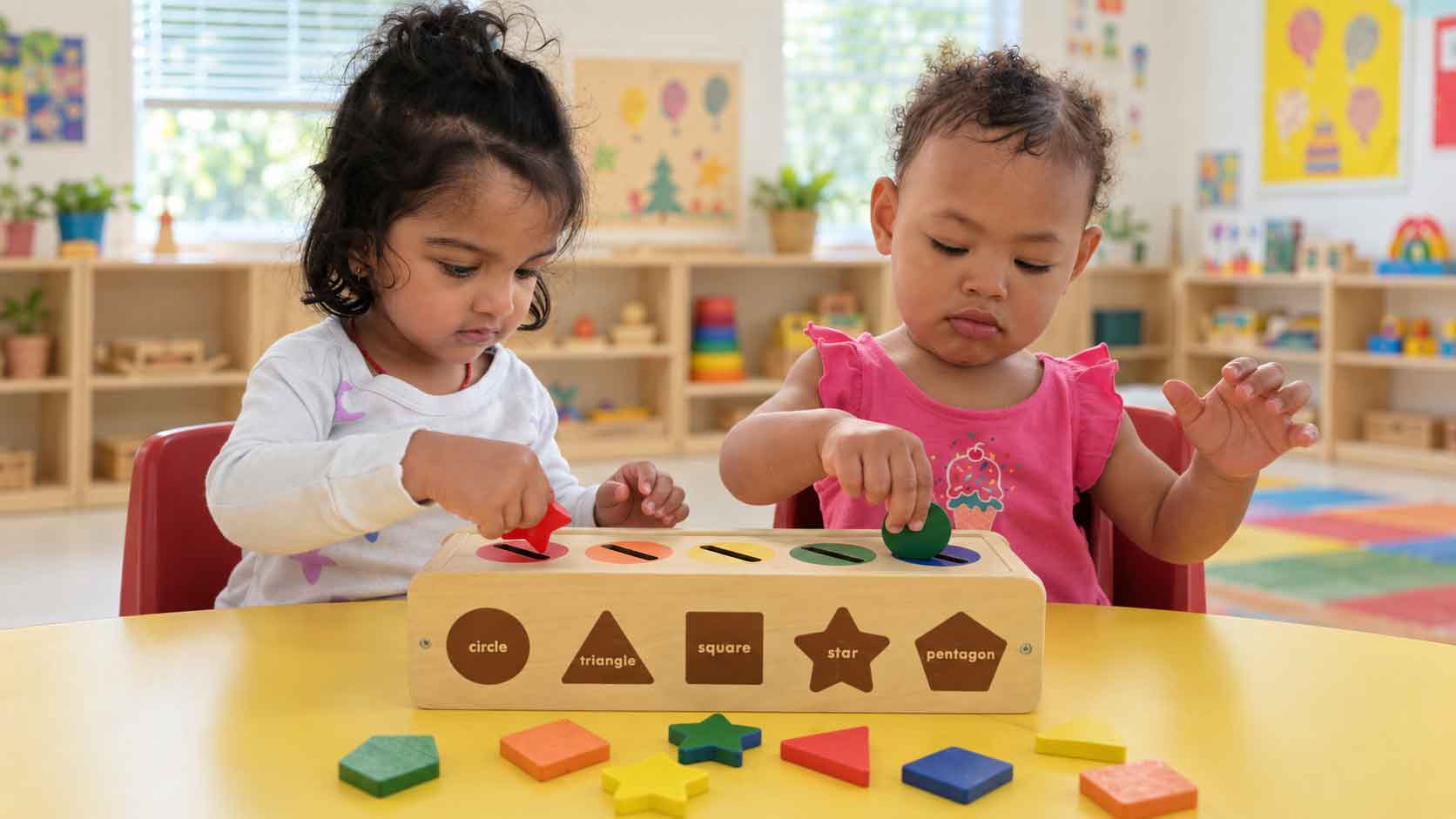
Montessori for toddlers gives young children an opportunity to begin learning in an environment designed around how they naturally develop. Toddlers may not be studying traditional academic subjects, but every day they are building language, coordination, concentration, independence, social awareness, and an understanding of the world around them.
This is why meaningful education does not have to wait until kindergarten or traditional preschool. A toddler who sorts objects, communicates a need, completes a simple practical task, carefully carries materials, or tries something independently is already learning through experience.
At Happy Flower Montessori Academy, we believe the toddler years are an important stage for purposeful early education. While an older child may be starting another year of public school, a younger child can begin a Montessori journey designed specifically for their developmental needs.
Montessori for Toddlers Recognizes Everyday Learning
A toddler may not sit at a desk studying traditional academic subjects, but that does not mean learning has not begun.
Watch a young child carefully. They are constantly observing adults, repeating sounds, carrying objects, opening containers, sorting items, testing movements, asking questions, and attempting to complete everyday tasks independently.
Montessori education recognizes the importance of these natural behaviors.
Instead of trying to make toddlers learn like older children, the Montessori environment is prepared around their developmental capabilities. Children encounter age-appropriate materials and experiences that encourage movement, language, coordination, concentration, practical skills, and exploration.
Learning becomes part of everyday life. Montessori for toddlers builds on this natural curiosity by providing age-appropriate experiences that encourage children to explore, move, communicate, and participate.
Independence Begins With Small Accomplishments
One of the most recognizable principles of Montessori education is independence.
For a toddler, independence does not mean doing everything without help. It means gradually developing the confidence and ability to participate in everyday life.
A child may begin learning how to put something back in its place, make a simple choice, carry an object carefully, clean up after an activity, communicate a need, or complete a task with less assistance.
To an adult, these achievements may appear small.
To a developing child, they can be enormous.
Every successful experience communicates an important message: I can do this.
Over time, those small moments help build confidence, responsibility, concentration, and self-reliance. This is one reason Montessori for toddlers places meaningful emphasis on age-appropriate independence rather than expecting adults to complete every task for the child.
A Prepared Montessori Environment Makes a Difference
Traditional adult environments can sometimes be overwhelming for toddlers. Furniture is too large, objects are out of reach, and children frequently need adults to complete simple tasks for them.
A Montessori environment takes a different approach.
The classroom is thoughtfully organized around children. Materials are accessible, activities have purpose, and children are encouraged to interact meaningfully with their surroundings.
Experienced educators observe each child and provide guidance without unnecessarily taking over the learning experience.
The goal is not to rush children.
It is to create the conditions that allow development to happen naturally and purposefully. In Montessori for toddlers, the prepared environment helps make everyday participation more accessible to young children.
Language and Social Development Begin Early
The toddler years are also an important period for communication.
At Happy Flower Montessori Academy, children experience opportunities for conversation, vocabulary development, songs, stories, social interaction, and bilingual exposure within the school environment.
They also begin learning something equally important: how to function within a community.
Waiting, sharing space, observing others, communicating needs, respecting materials, and participating in routines all contribute to social development.
These experiences help prepare children not only for future classrooms but also for everyday relationships. Montessori for toddlers therefore considers communication and social interaction important parts of early development.
Your Children Can Begin Different Educational Journeys at the Same Time
Perhaps your older child has already started public school this September.
That does not mean your toddler needs to wait several more years before experiencing a purposeful educational environment.
Their education will naturally look different.
Your older child may be reading textbooks, completing assignments, and moving between subjects. Your toddler may be developing vocabulary, practicing coordination, exploring practical life activities, and learning how to become more independent.
- Both are learning.
- Both are developing.
- Both deserve an environment appropriate for their stage of life.
September Can Be the Beginning of Your Toddler’s Montessori Journey
Parents sometimes think enrollment opportunities disappear once September arrives. But the beginning of the school year can also be the moment families recognize that their younger child is ready for something more structured and meaningful.
At Happy Flower Montessori Academy, families in Plano and McKinney can explore Montessori for toddlers in an environment designed around the developmental needs of young children.
You do not have to wait for your toddler to become a preschooler before giving them an environment where curiosity is taken seriously.
While one child begins another year of school, another can begin an entirely new journey.
Explore Montessori for Toddlers in Plano and McKinney
Plano location & contact:
📍 913 Lexington Dr., Plano, TX 75075
🌐https://www.happyflowermontessori.com/
McKinney location & contact:
📍 3801 Alma Rd., McKinney, TX 75070
🌐https://www.hfmontessorimckinney.org/
📞 +1 (682) 351 9492
Leave a Reply